Parents comparing early-childhood programs often search for Montessori vs. daycare vs. preschool as if those labels describe three uniform models. They do not. Montessori is an educational approach with recognizable core practices. Child-care centers are a type of care setting and can use many different curricula. Preschool or pre-K programs can also follow a wide range of philosophies, schedules, and teaching methods.
The useful question is not which label is universally best. It is which specific program offers the learning environment, schedule, teacher preparation, safety, communication, and family fit your child needs.
Montessori Enrollments helps families compare Montessori schools across all 50 states before contacting schools for tours and enrollment information.
First, Understand What the Labels Actually Mean
Program Label | What the Label Usually Describes | What Can Vary |
Montessori | An educational approach built around a prepared environment, trained adults, hands-on materials, child-directed work, mixed ages, and sustained work periods. | Fidelity to Montessori principles, accreditation, teacher credentials, hours, tuition, and school type. |
Child-care center / daycare | A center-based setting that provides care for groups of children, often full-time and often organized by age. | Curriculum, teacher training, ratios, hours, philosophy, licensing status, and educational emphasis. |
Preschool / pre-K | An early-learning program generally serving preschool-age children, often with a school-readiness focus. | Public/private status, full-day vs. part-day, curriculum model, eligibility, calendar, and teaching approach. |
Montessori Is a Method, Not Just a Type of Building
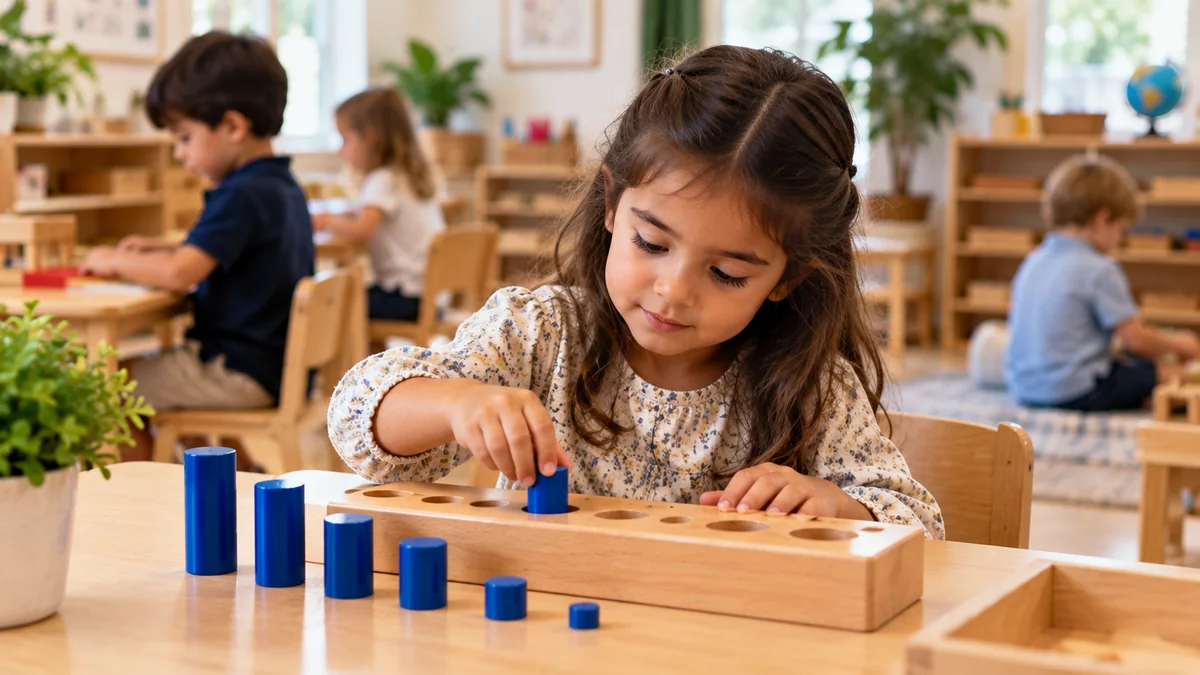
AMI describes Montessori environments as carefully prepared for child-centered learning, with accessible furniture, multiple work spaces, hands-on materials, free choice within logical limits, and a trained adult who observes and guides individual development.
AMS highlights five core components of quality Montessori: trained Montessori teachers, multi-age classrooms, Montessori materials, student-directed work, and uninterrupted work periods. Because the Montessori name can be used broadly, parents should verify how consistently a school actually implements those components.
Daycare Describes Care Structure More Than Curriculum
ChildCare.gov describes child-care centers as group-care settings that often provide full-time care and may serve infants, toddlers, preschoolers, and school-age children. Many group children by age. A child-care center can use play-based learning, a commercial curriculum, Reggio Emilia-inspired practices, Montessori, faith-based programming, or another approach.
That means ‘daycare’ does not automatically mean less educational, just as ‘Montessori’ does not automatically mean higher quality. The curriculum, adult-child interactions, teacher preparation, environment, licensing, and daily schedule have to be evaluated at the individual program level.
Traditional Preschool or Pre-K Can Take Many Forms
ChildCare.gov describes prekindergarten programs as generally serving children ages 3 to 5 and focusing on preparation for kindergarten. They may be offered by public schools, nonprofit organizations, places of worship, or child-care centers, and some operate only during the school year or part of the day.
Some preschools use teacher-led whole-group instruction; others emphasize centers, play, projects, outdoor learning, or a blended model. Ask what the classroom actually looks like rather than assuming ‘preschool’ means one teaching style.
1. Mixed Ages vs. Same-Age Grouping
Montessori intentionally groups children across a developmental age span. AMI’s 3-6 environment, for example, brings together children across roughly three years. This creates opportunities for younger children to observe older peers and for older children to reinforce skills through leadership and community responsibility.
Many child-care centers and preschools group children more narrowly by chronological age, although this varies. Neither structure automatically guarantees stronger relationships; visit and observe how the group actually functions.
2. Teacher Role: Guide vs. Whole-Group Instructor
In Montessori, the adult often gives concise individual or small-group presentations, observes children, and connects each child with appropriate materials. The classroom is designed so learning does not depend on the teacher talking to the whole group all day.
Other preschool models may use more teacher-led songs, calendar time, group lessons, centers, projects, or scheduled rotations. The right fit can depend on your child’s temperament and how well the teachers execute their chosen model.
3. Choice and the Daily Schedule
Montessori protects extended periods in which children choose from developmentally appropriate work after receiving lessons. The choice is structured: children work within classroom limits and with materials they know how to use.
Other early-childhood programs may use shorter blocks with planned transitions. Ask how often children choose activities, how long they can stay with one activity, and how frequently the entire group is expected to change tasks together.
4. Hands-On Materials and Play
Montessori materials are intentionally sequenced and often isolate a specific skill or concept. Practical Life, Sensorial, language, mathematics, culture, and everyday care of the environment are integrated into the classroom.
Other high-quality early-childhood programs may use dramatic play, blocks, art, sensory centers, books, open-ended manipulatives, outdoor play, and teacher-created experiences. Compare the depth, organization, and purpose of activities rather than counting how many toys or materials are visible.
5. Independence
Montessori environments are deliberately arranged so children can do more for themselves: choose work, carry materials, pour, clean, dress, prepare food, care for the room, and solve manageable problems with gradually decreasing adult assistance.
Other programs can also foster independence. During a visit, watch whether adults regularly do tasks for children that children could reasonably attempt themselves, or whether the environment gives children meaningful responsibility.
6. Hours, Calendar, and Practical Family Needs
Educational philosophy only works for a family if the logistics work too. Child-care centers often provide longer full-day or year-round schedules, while some Montessori and pre-K programs follow a school-day or school-year calendar. Many Montessori schools also offer extended care.
Drop-off and pickup times
Full-day vs. half-day availability
Summer and holiday coverage
Nap/rest policies
Meals and snacks
Before- and after-school care
Minimum attendance expectations
7. Licensing, Accreditation, and Teacher Credentials
Licensing and accreditation answer different questions. State child-care licensing generally addresses required health, safety, staffing, and operating standards. Montessori accreditation or affiliation can indicate adherence to Montessori-specific standards.
A Montessori school may be licensed, license-exempt under state rules, accredited by a Montessori organization, affiliated but not accredited, or independent. Ask what each credential means in your state and for that specific school.
A Better Comparison Than ‘Which One Is Best?’
If Your Priority Is… | Questions to Ask Any Program |
Long uninterrupted concentration | How often are children required to transition? How long can they stay with self-chosen work? |
Full-day care | What are the earliest drop-off and latest pickup times? Is care year-round? |
Montessori fidelity | What training do teachers have? Are ages mixed? Is there a sustained work cycle? |
Play and creativity | What kinds of open-ended, dramatic, artistic, outdoor, and imaginative experiences are available? |
Kindergarten readiness | How does the program support language, early math, self-regulation, social skills, and independence? |
Individual support | How does the teacher identify developmental needs and communicate concerns to families? |
How to Compare Real Programs, Not Stereotypes
Start with your child’s age, temperament, developmental needs, and daily schedule.
List the non-negotiable logistics: location, hours, tuition, calendar, and availability.
Ask each school to explain its curriculum in plain language.
Observe adult-child interactions rather than judging only the room decor.
Ask how teachers are trained and how staff turnover is handled.
Look at how children spend a normal morning, not just special activities.
Review licensing, accreditation, and safety information.
Tour more than one program before deciding.
Montessori Can Exist Inside Different School Types
Montessori programs can be private, public, charter, nonprofit, faith-based, or part of an early-childhood center. The philosophy and classroom practice matter more than whether the building is called a school, academy, preschool, or child-care center.
For parents, that makes direct comparison especially useful: age ranges, accreditation, program type, hours, tuition, and the actual classroom experience can vary significantly.
Use the Directory to Build a Local Shortlist
Montessori Enrollments lists 3,200+ Montessori schools across all 50 states and allows families to compare programs, ages served, tuition information where available, and parent reviews before contacting schools directly.
Once you find nearby options, tour the schools and compare what you observe. The best decision is the one that fits both your child’s developmental needs and the realities of your family’s daily life.
Sources and References
Montessori Enrollments – National School Directory
Association Montessori Internationale – Montessori Environments
Association Montessori Internationale – Montessori 3-6
American Montessori Society – What Is Montessori?
Frequently Asked Questions
Is Montessori the same as preschool?
Montessori is an educational approach, while preschool is a broad term for early-childhood education before kindergarten. A preschool can use Montessori, another named curriculum, or an eclectic approach.
Is Montessori better than daycare?
There is no universal answer. Daycare describes a care setting more than one curriculum, and quality varies widely. Compare the specific program’s teaching approach, adult-child interactions, teacher training, hours, licensing, safety, communication, and fit for your child.
What age can a child start Montessori?
Montessori programs can begin in infancy. AMI describes 0-3 environments and 3-6 Children’s House programs, followed by elementary and adolescent levels. Individual schools may start at different ages, so check the program offered by each school.
