
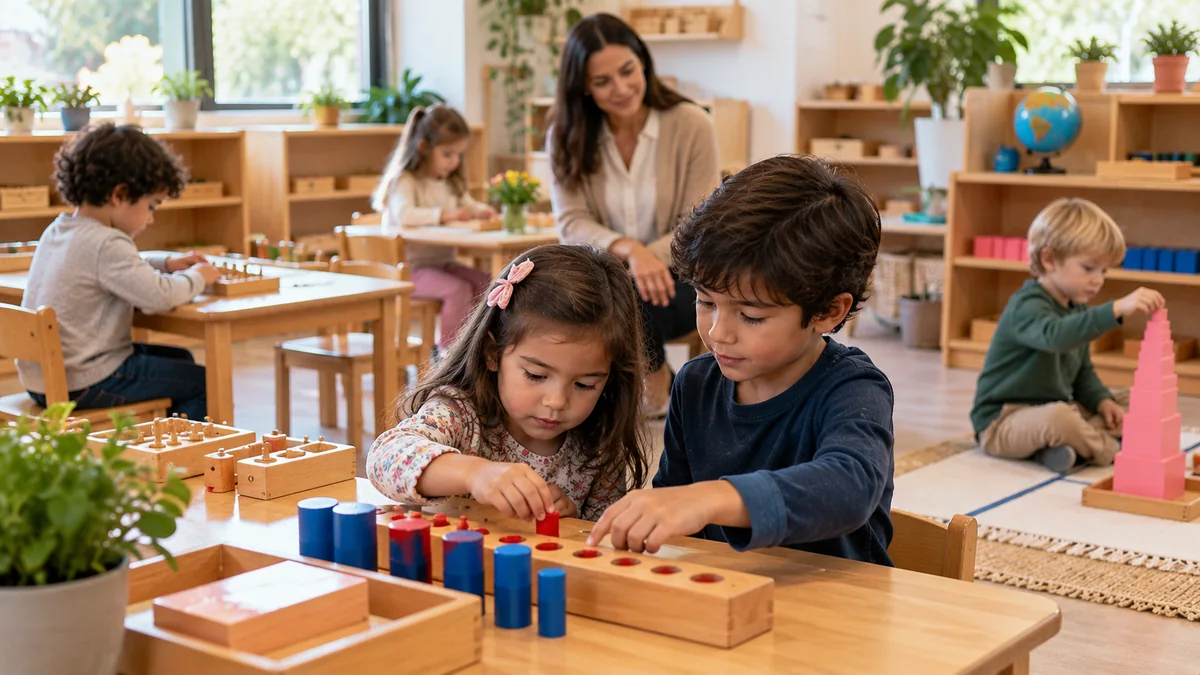
One of the first things parents notice when researching Montessori schools is that classrooms are not always organized by a single grade or birthday. A 4-year-old may work near a 5-year-old. A 7-year-old may collaborate with an 8- or 9-year-old. This is not a scheduling shortcut. Montessori mixed-age classrooms are a core feature of the educational model.
The American Montessori Society (AMS) identifies multi-age classrooms as one of five core components of Montessori education, while the Association Montessori Internationale (AMI) describes mixed-age communities as a setting where younger children learn through observation and older children strengthen understanding through mentoring. For parents using Montessori Enrollments to compare schools, understanding this structure makes it easier to ask better questions during tours and evaluate whether a program reflects Montessori practice.
What Does “Mixed-Age” Mean in Montessori?
Montessori classrooms are usually organized around developmental stages rather than one-year grade levels. AMS-approved groupings commonly include Early Childhood ages roughly 2.5–6, Lower Elementary ages 6–9, Upper Elementary ages 9–12, and corresponding multi-year groupings at the infant, toddler, and secondary levels.
The exact ranges can vary because state licensing rules, school structure, enrollment size, and program design differ. The important feature is not the label on the room—it is the presence of a meaningful age span within the same developmental stage.
Why Montessori Uses a 3-Year Cycle
AMI describes the three-year cycle as more than an organizational device. It gives children time to become familiar with the prepared environment, deepen skills through repetition, build relationships, and gradually take on greater responsibility.
Stage in the Cycle | Typical Experience | What Parents May Notice |
First year | Learning routines, materials, and classroom culture | Observation, imitation, growing trust and independence |
Second year | Repeating work, building mastery, making more independent choices | Longer concentration and stronger confidence |
Third year | Applying prior learning and helping sustain the classroom community | Leadership, mentoring, responsibility, and deeper mastery |
The Younger Child Gains Models Without Being Rushed
In a single-age classroom, adults often provide most examples of what comes next. In a Montessori environment, younger children also see peers using more advanced materials, managing routines, resolving small social problems, and taking responsibility for the classroom.
That exposure can make future learning feel familiar before a formal lesson ever happens. The younger child is not expected to perform at the older child’s level. Instead, the environment quietly shows what is possible.
The Older Child Learns by Becoming Capable
Mixed-age grouping is not only designed for younger students. Older children benefit from being among the most experienced members of the community. They can model routines, answer questions, collaborate, and sometimes show a younger peer how to complete familiar work.
Explaining an idea to someone else can reinforce the older child’s own understanding. More importantly, leadership in Montessori is often practical rather than performative: returning materials correctly, caring for the environment, working independently, and knowing when help is actually useful.
Why Mixed Ages Do Not Mean Every Child Does the Same Work
A common concern is that a classroom spanning several ages might teach one lesson to everyone at once. High-quality Montessori works differently. Teachers observe individual readiness and give lessons to children individually or in small groups. Children then practice with materials appropriate to their developmental level.
The classroom can therefore contain a wide range of work at the same time. A younger child might refine practical-life or early language skills while an older classmate works with more advanced mathematics or reading. The shared room creates community without requiring identical pacing.
How the 3-Year Cycle Supports Continuity
Children have time to learn the classroom culture instead of starting over every school year.
Teachers can observe development across a longer period and introduce lessons when readiness appears.
Relationships with classmates can deepen rather than being completely reshuffled each year.
Materials remain familiar while the child’s ability to use them becomes more advanced.
The child has a realistic path from newcomer to experienced member of the community.
This is one reason Montessori families often hear schools encourage completion of a full cycle, particularly the third Early Childhood year that commonly corresponds with kindergarten age. The point is not that leaving early automatically harms a child; it is that some of the social and academic benefits of the model are designed to emerge over time.
What Parents Should Look for During a School Visit
A mixed-age label alone does not tell you how well the classroom is functioning. When comparing Montessori schools near you, look for the interaction between age grouping, teacher preparation, materials, freedom, and classroom order.
Purposeful independence: Children should be able to choose and carry out meaningful work without constant adult direction.
Real age diversity: Ask which ages share the classroom and how long children typically remain in that level.
Trained guides: Ask what Montessori credentials the lead teachers hold for the age level they teach.
Peer learning without forced tutoring: Older children may help younger peers naturally, but should not be used as substitute teachers.
Long work periods: Mixed-age communities work best alongside sustained time for individual and small-group activity.
Respectful classroom culture: Look for calm movement, accessible materials, and children who know how to care for shared space.
Mixed-Age Classrooms and Accreditation Are Related—but Not Identical
Accreditation can be useful information, but families should still look closely at actual classroom practice. AMS, for example, includes multi-age grouping in its accreditation standards. A school may also follow Montessori principles without holding a specific accreditation, depending on its affiliation, history, region, or stage of development.
That is why Montessori Enrollments lets families compare program information rather than relying on a single label. The strongest school choice comes from combining profile details with direct questions and an in-person or virtual visit.
Use the Classroom Structure as a Window Into the Program
For parents, mixed-age grouping is useful because it reveals more than the children’s birthdays. It shows whether the school is organized around developmental continuity, individual pacing, peer learning, and growing independence.
When you search Montessori schools by location, compare the age ranges listed in school profiles and then ask how the school supports the full cycle. The best answer should connect classroom structure to what children actually do each day—not just to a marketing label.
Suggested Internal Links
• Montessori schools near you — Primary directory/search experience for parents comparing programs.
• Montessori Enrollments — Connects the educational guide to the site’s parent-facing school discovery mission.
• how Montessori schools communicate with prospective families — Related content on what parents look for before scheduling a tour.
Authoritative References
• American Montessori Society — Multi-Age Groupings in Montessori Classrooms
• Association Montessori Internationale — The Magic of the Three Year Cycle
• AMI Digital — Mixed-Age Groups
• American Montessori Society — 5 Core Components of Montessori Education
FAQ: Montessori Mixed-Age Classrooms
Will my younger child be behind the older children?
The classroom is not designed as a competition among ages. Children receive lessons according to readiness and work with materials appropriate to their level. Older children mainly provide examples of what future development can look like.
Will an older child be bored if younger children are in the room?
A well-prepared Montessori environment includes increasingly complex materials and lessons for older students. Their work should continue to advance academically while the social role of being an experienced community member adds another dimension to learning.
Does every Montessori school use exactly the same age groupings?
No. Common Montessori ranges are similar, but state regulations, school size, program offerings, and affiliation can affect grouping. Ask each school for the age range in the classroom you are considering and how that grouping supports the curriculum.
